
SOMA Lab
News

Published in Chemical Engineering Journal: Reversible Thermochromism in Polydiacetylene Vesicles
Our paper on reversible thermochromism in polydiacetylene vesicles has been published in Chemical Engineering Journal. Polydiacetylene (PDA) vesicles change color from blue to red when heated, but the change is usually irreversible because the polymer backbone does not return to its original packing. In this work, we designed diacetylene monomers with a dual hydrogen-bonding motif: an internal amide group reinforces the molecular packing scaffold, and a terminal carboxylic acid group forms hydrogen bonds at the vesicle–water interface to promote packing recovery. As a result, the PDA vesicles turn from blue to red on heating up to 100 °C and return to blue on cooling to room temperature. On filter paper, the reversible color change is maintained up to 170 °C. This work was led by Chanhee Yang in collaboration with Prof. Jong-Man Kim (Hanyang University). C. Yang, J.-M. Heo*, J.-M. Kim*, Chem. Eng. J. 182756 (2026). Full text: https://doi.org/10.1016/j.cej.2026.182756
Published in Nature Communications: Microchiral Pinwheel Arrays from Achiral Molecules
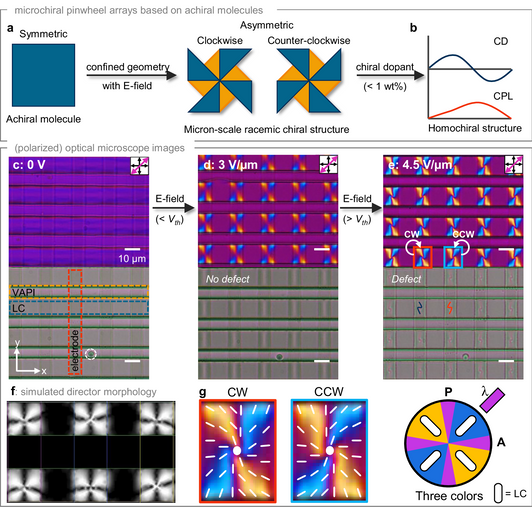
Our paper on microchiral pinwheel arrays built from achiral molecules has been published in Nature Communications. Chirality usually has to be built into the molecules themselves. In this work, an achiral nematic liquid crystal confined in microchannels and driven by an in-plane electric field breaks mirror symmetry on its own, forming regular arrays of clockwise and counter-clockwise pinwheel domains. Adding less than 1 wt% of a chiral dopant biases this process so that a single handedness is selected over large areas. Using chemical vapor polymerization, we then fixed these structures into chiral polymer nanofiber scaffolds that remain after the liquid crystal is removed. Achiral emitters coated on the scaffolds show circularly polarized luminescence whose sign follows the handedness of the scaffold. This work was carried out in collaboration with Prof. Dong Ki Yoon (KAIST) and Prof. Kyung Jin Lee (Chungnam National University). J. Y. Han, W. K. Park, B. Noh, F. Araoka, S. Jeong, B. H. Jhun, Y. You, Y. Park, K. J. Lee*, J.-M. Heo*, D. K. Yoon*, Nat. Commun. 17, 9413 (2026). Full text: https://doi.org/10.1038/s41467-026-76089-z

Published in ACS Applied Materials & Interfaces: Robust, Amine-Rich Mussel-Inspired Coatings
Our collaborative paper on mussel-inspired nanoscale coatings has been published in ACS Applied Materials & Interfaces. The paper reports mussel-inspired nanoscale coatings that are rich in primary amines and chemically robust, and that form through a pathway that does not depend on cation–π interactions. This work was carried out with Prof. Jinsang Kim's group and Prof. Zhan Chen's group at the University of Michigan. M. I. Hasan, M.-H. Lee, C. Yu, D. Seo, Y. Wu, J.-M. Heo, Z. Chen, J. Kim*, ACS Appl. Mater. Interfaces 18, 33402–33413 (2026). Full text: https://doi.org/10.1021/acsami.6c05964

Published in Nature Communications: Reversible Phosphorescence Color Switching for Data Encryption
Our paper on reversible phosphorescence color switching in a purely organic crystal has been published in Nature Communications. Purely organic phosphors rarely change their emission color reversibly without losing brightness. In this work, we designed BrGlu, a dibromoterephthaloyl compound bearing bulky glutarimide groups, which forms two crystal types: a solvent-free crystal with green phosphorescence and a chloroform solvate with blue phosphorescence. The green crystal converts to the blue form in chloroform, and mild heating (about 60 °C) removes the solvent and restores the green emission. Single-crystal analysis and quantum-chemical calculations show that the color change originates from syn–anti reorientation of the bromine–carbonyl substituents. Both crystals remain highly emissive, with phosphorescence quantum yields of 93% (green) and 43% (blue). We used this switching to build a data encryption platform that requires two sequential keys to read the stored information. This work was carried out in collaboration with Prof. Jinsang Kim (University of Michigan), Prof. Min Sang Kwon (Seoul National University), Prof. Johannes Gierschner (IMDEA Nanociencia), and Prof. Adam J. Matzger (University of Michigan). J.-M. Heo, H. Woo, M. F. Florez-Angarita, J. Park, B. Milian-Medina, A. J. Matzger, J. Gierschner*, M. S. Kwon*, J. Kim*, Nat. Commun. 17, 3039 (2026). Full text: https://doi.org/10.1038/s41467-025-65225-w

SOMA Lab Opens at Ajou University
Prof. Jungmoo Heo joined Ajou University on March 1, 2026 as an Assistant Professor in the Department of Applied Chemistry and the Department of Molecular Science and Technology, and the SOMA Lab (Supramolecular Organic Materials & Assembly Lab) opened in Room 603, Yeonam Hall. The lab studies how the way organic molecules pack and assemble determines their optical and mechanical function, and uses these rules to design materials that emit, absorb, and respond to light, heat, and chemical stimuli. We are recruiting graduate students for March 2027 entry, and undergraduate researchers are welcome at any time. See Join us for details.