
SOMA Lab
Research
We design organic molecules and their assemblies to control how materials emit, absorb, and respond to light, heat, and chemical stimuli, combining synthesis, crystal and liquid-crystal engineering, photophysics, and quantum-chemical calculations with machine learning.
How we work
Calculation and experiment run as one loop in our lab: machine learning and quantum chemistry choose which molecules we make, and check what we measure.
- PredictAI
Quantum-chemical calculations and machine-learning models screen candidate molecules for emission color, spin–orbit coupling, and lifetime before we make them.
- Make
We synthesize the most promising candidates.
- Assemble
We arrange them in crystals, liquid crystals, polymers, and supramolecular assemblies.
- Measure
We measure steady-state and time-resolved emission, chiroptical response, and structure.
- ExplainAI
Calculations and models check the measured results and reveal the mechanism behind them. Each round of data refines the next prediction.

Purely Organic Phosphors
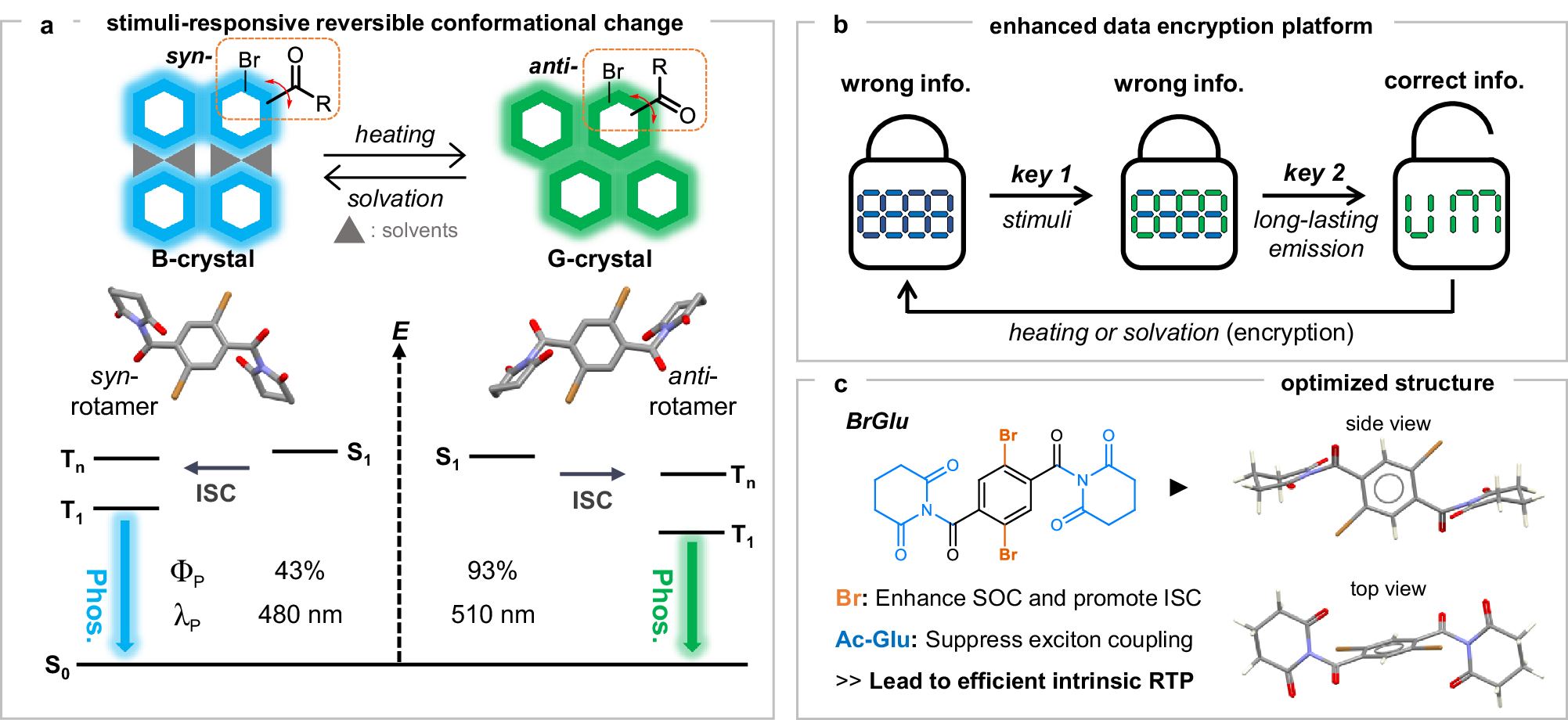
Metal-free phosphors are attractive for displays, sensing, and security inks, but their triplet emission is usually slow and easily quenched. We study how molecular conformation and crystal packing control spin–orbit coupling, and use these rules to design organic phosphors with fast, bright, and switchable room-temperature phosphorescence.
- Carbonyl orientation and spin–orbit coupling in brominated aromatics
- Polymorph- and pseudopolymorph-dependent emission
- Phosphorescence color switching for data encryption
Selected papers

Circularly Polarized Luminescence
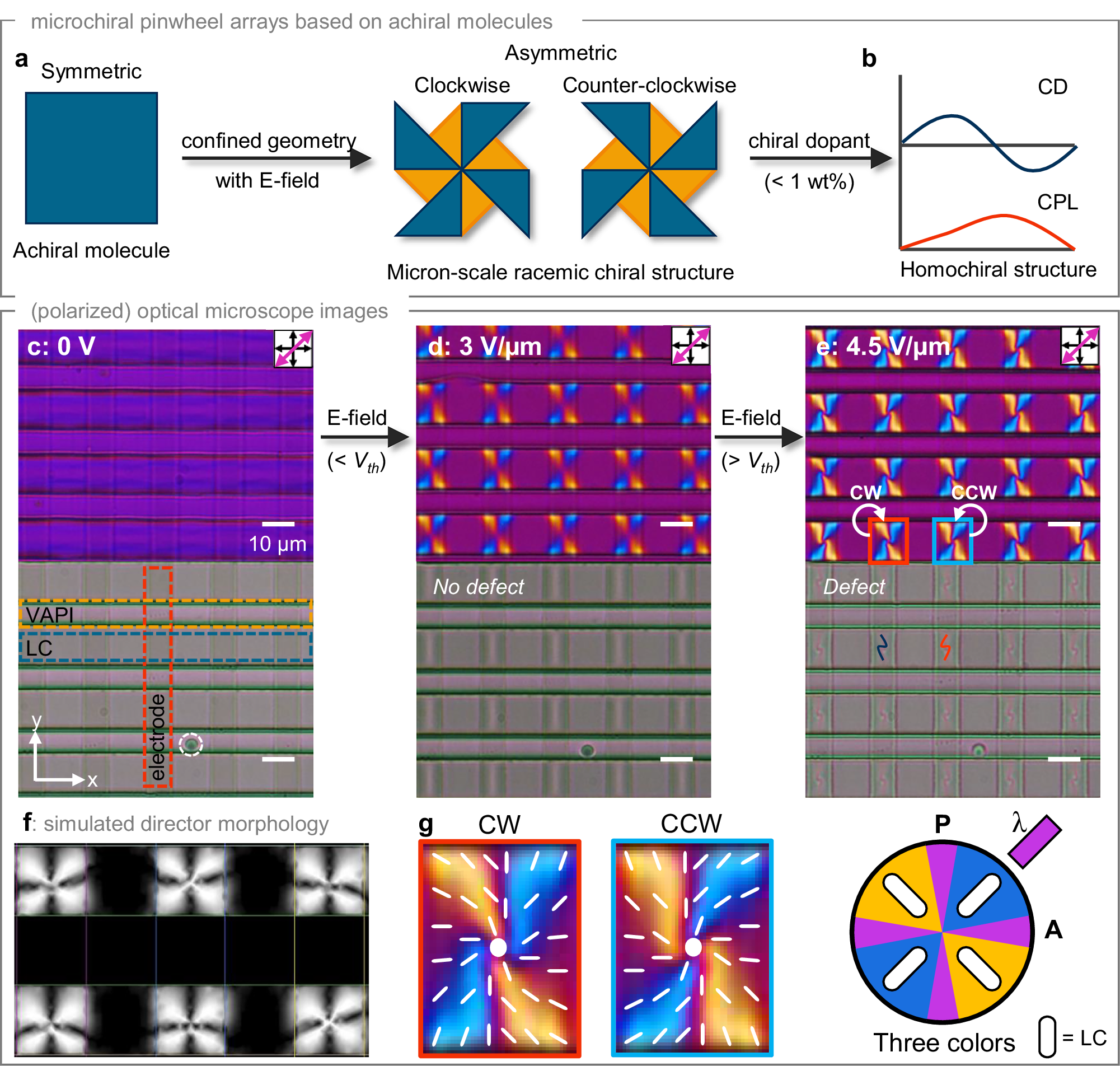
Circularly polarized luminescence (CPL) is needed for 3D displays and optical encryption. We build chiral supramolecular assemblies that transfer chirality to luminescent molecules, using approaches such as chiral self-assembly and liquid-crystal templating, and we study how the sign and magnitude of CPL can be controlled.
- Chiral supramolecular assemblies of luminescent molecules
- Liquid-crystal-templated chiral scaffolds
- Circularly polarized phosphorescence and full-color CPL
Selected papers
- Microchiral pinwheel arrays based on achiral moleculesNat. Commun. 17, 9413 (2026)
- Hierarchical Chiral Spindle Microbeads for Full-Colour Circularly Polarized LuminescenceAdv. Mater.Under revision
- Color-tunable, high-dissymmetry circularly polarized phosphorescence in chiral nematic phases: self-assembly, energy transfer, and handedness inversionMater. Chem. Front. 9, 3188–3196 (2025)
- Directed Chiral Self-Assembly of Purely Organic Phosphors for Room-Temperature Circularly Polarized PhosphorescenceAdv. Opt. Mater. 12, 2400572 (2024)

Chromogenic Polymers and Sensors
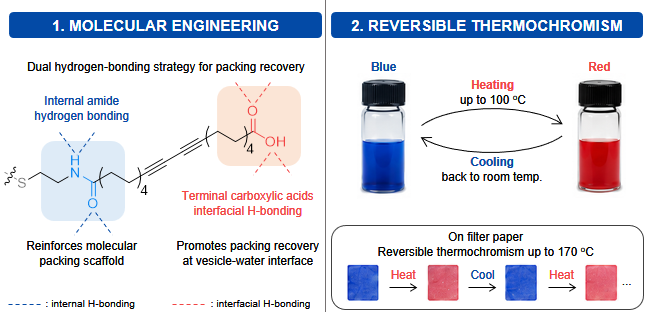
Polydiacetylenes change color in response to heat, solvents, and molecular recognition. By engineering hydrogen bonding and packing in the monomers, we develop reversible color-changing materials and simple colorimetric sensors for temperature, volatile organic compounds, and biomolecules.
- Reversible thermochromism in polydiacetylene vesicles
- Colorimetric sensing of volatile organic compounds and biomolecules
- Self-assembled macrocyclic diacetylenes and nanotubes
Selected papers
- Molecular Engineering Enables Reversible Thermochromism in Polydiacetylene VesiclesChem. Eng. J. 182756 (2026)
- A diaminotriazine-functionalized polydiacetylene for colorimetric sensing of thymine and oligothymidineSens. Actuators B: Chem. 390, 133871 (2023)
- Smartphone-based VOC sensor using colorimetric polydiacetylenesACS Appl. Mater. Interfaces 10, 5014–5021 (2018)

Sustainable Adhesives and Soft Materials
Mussel-inspired catechol chemistry offers strong adhesion to diverse surfaces. We study catechol–amine crosslinking and supramolecular interactions to design adhesives and coatings, and extend these ideas to responsive soft materials such as hydrogels.
- Catechol–amine crosslinked coatings and adhesives
- Supramolecular structural adhesives
- Stimuli-responsive hydrogels
Selected papers
- Chemically Robust, Primary Amine Rich Mussel-Inspired Nanoscale Coatings via a Cation-π Interaction Independent PathwayACS Appl. Mater. Interfaces 18, 33402–33413 (2026)
- Polydopamine Adhesion: Catechol, Amine, Dihydroxyindole, and Aggregation DynamicsACS Appl. Mater. Interfaces 16, 31864–31872 (2024)