
Published in Nature Communications: Reversible Phosphorescence Color Switching for Data Encryption
Our paper on reversible phosphorescence color switching in a purely organic crystal has been published in Nature Communications.
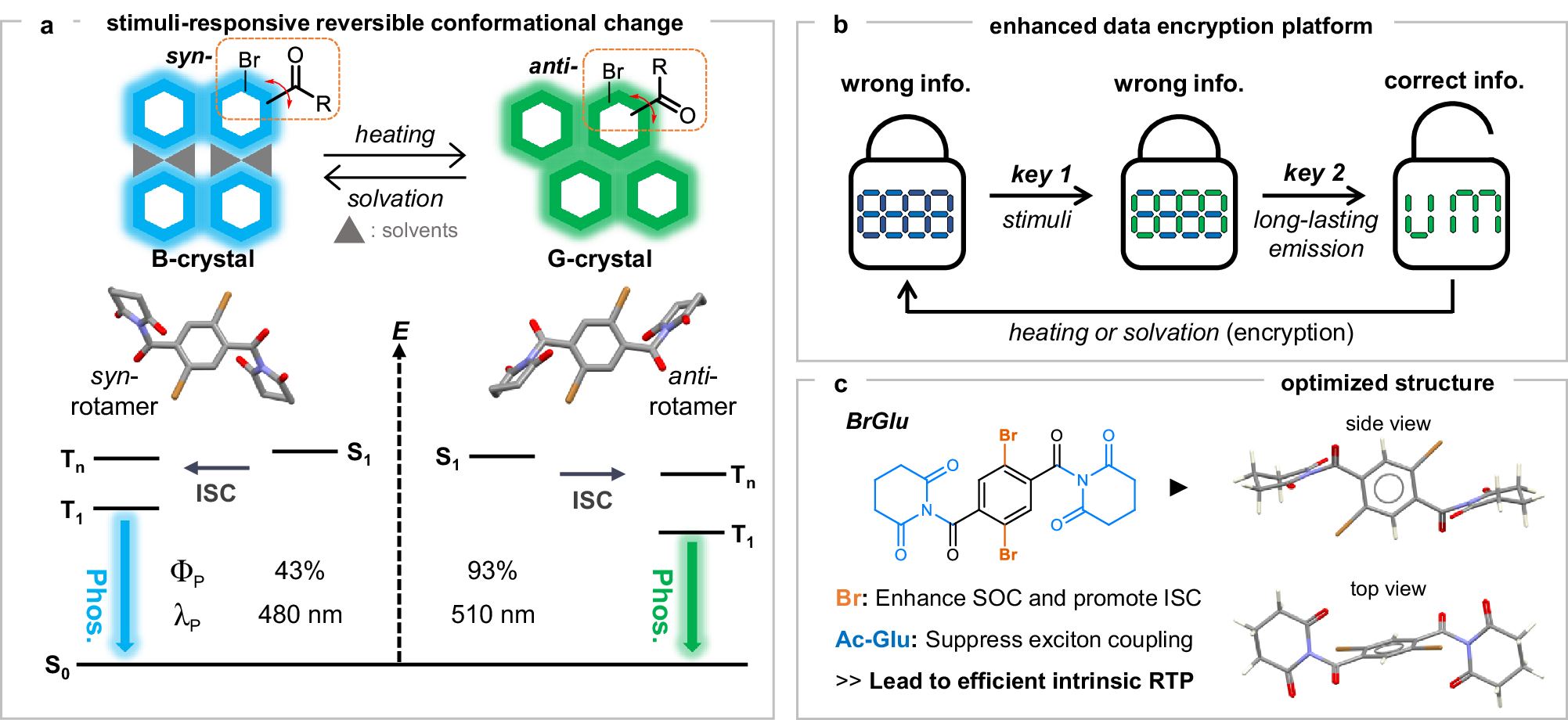
Purely organic phosphors rarely change their emission color reversibly without losing brightness. In this work, we designed BrGlu, a dibromoterephthaloyl compound bearing bulky glutarimide groups, which forms two crystal types: a solvent-free crystal with green phosphorescence and a chloroform solvate with blue phosphorescence. The green crystal converts to the blue form in chloroform, and mild heating (about 60 °C) removes the solvent and restores the green emission.
Single-crystal analysis and quantum-chemical calculations show that the color change originates from syn–anti reorientation of the bromine–carbonyl substituents. Both crystals remain highly emissive, with phosphorescence quantum yields of 93% (green) and 43% (blue). We used this switching to build a data encryption platform that requires two sequential keys to read the stored information.
This work was carried out in collaboration with Prof. Jinsang Kim (University of Michigan), Prof. Min Sang Kwon (Seoul National University), Prof. Johannes Gierschner (IMDEA Nanociencia), and Prof. Adam J. Matzger (University of Michigan).
J.-M. Heo, H. Woo, M. F. Florez-Angarita, J. Park, B. Milian-Medina, A. J. Matzger, J. Gierschner*, M. S. Kwon*, J. Kim*, Nat. Commun. 17, 3039 (2026).
Full text: https://doi.org/10.1038/s41467-025-65225-w